Putting Down the Robot Dog Again
I discovered AIBO during a school assembly, in 1st grade. It was probably 2008: the internet was normal, smartphones had already changed society forever. "Peanut butter jelly time" was playing on someone's iPod Touch on the school bus. Flash animations had already transitioned from websites like Albino Blacksheep to YouTube. Learning to type was part of Kindergarten curriculum. Students crammed into the art classroom a few times that year for a short series of "career presentations". First, zoology, then, robotics. The presenter produced an AIBO from a black camera case. It didn't matter that the consumer electronics revolution had already happened; what I saw completely blew my mind. AIBO's novelty hadn't been normalized at all, but by then, it had already been discontinued for the first time.
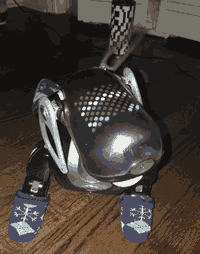
Bruno-Bruno, the happiest guy not alive.
His insane backstory deserves its own post.
If you aren't familiar with the history of this obscure home robotics experiment, here are the cliffsnotes. In February 1988, Sony started a R&D center called the Computer Science Laboratories, or CSL, in Tokyo. In Out of the Lab and on the Market, then promotion manager of the CSL, Tetsu Natsume stated the goal of the CSL as: “to contribute extensively to social, industrial, and SONY development through fundamental yet applicable research, especially on and around computer science." He continues: "SONY is the 'also' there -- contributing to humanity and society comes first for CSL."
Throughout the 90's, a CSL researcher, Toshitada Doi, started prototyping robotic creatures after being inspired by MIT's Genghis. He envisions an "entertainment robot with no clear role or job". By 1999, these prototypes have turned into the first AIBO: the ERS-110, which sells out in 20 minutes.
Following the ERS-110, Sony releases three more discrete models. Each had several incremental upgrades and cumulatively dozens of color options. Sony positions the robots as a kind of brand ambassador, and sells approximately 150,000 units. By 2006, Sony is struggling financially, losing the war on flat screen TVs to a comical degree. The robotics projects are gutted, and sales cease. This announcement reaches the news cycle, and the reaction is a genuine expression of sadness. Users petition Sony executives. AIBO remains defunct.
Then, unexpectedly, AIBO development begins again by 2016. Sony says it starts in secret among engineers on the Xperia team (hence why AIBO has LTE and a Snapdragon processor) before being commercialized. It is released as the ERS-1000 in 2018, and Sony starts stylizing the once capitalized backronym AIBO as 'aibo'.
Now, AIBO is 'dead' again. This post, like everything else I try to write about on this blog, is late. Sony announced the end of the ERS-1000's sales in June.
The contrast feels stark. When word of the latest discontinuation got out, people nodded pensively, like it was time to put down an elderly dog that had been sick for a while. The landscape has changed, but the products aspire to deliver on the same fundamental goals: AIBO exists for no reason other than the fact that it is pleasant to have around.
Personality As A Service
The original AIBO stored its data to Sony's ill-fated flash memory format, the Memory Stick. Like a game console, Sony sold first-party software and managed licenses so third-party developers could release software as well. Some of these products were utilities, i.e. teleoperation. Most of them were virtual pet simulators, enabling AIBO to 'grow' and change over time.
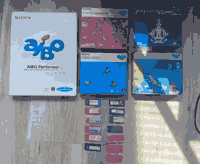
My modest collection of AIBO software and Sony memory sticks.
General-purpose memory sticks can be reformatted to work on AIBO through means.
When AIBO took a photo, it would save the photo to its memory stick. If it wrote a diary entry, learned its name, or was scolded for performing an annoying trick, it saved that, too. If you purchase AIBO secondhand, and its owner hasn't reset the software, you inherit alongside it a tiny slice of memory.
The ERS-1000 had no removable storage. It had a single software option that was incrementally updated since its release. In the US, it shipped with a 3-year license to the "cloud plan", which served the updates over the year. If you didn't renew your cloud plan, updates would stop. If you allowed your cloud plan to expire and then reactivated it later, the data that used to be available would be completely missing. At its core, the new AIBO was Software as a Service. It had an app.
Instead of the SaaS model rapidly improving the platform's software, updates to the ERS-1000's personality were mostly subtle. 8 total major updates were released from 2018 to 2026, and to me, 3 of these were interesting. Update 5.00 retuned the robot's gait to improve its reliability indoors. Update 7.00 introduced the ability for AIBO to pick up and manipulate objects it is directed to and follow the user around. Only the final update 8.00, released just before discontinuation, overhauled the slow and buggy mobile app interface.
I don't think the ERS-1000's software was terrible. On the contrary, I think it achieved the difficult task of being a virtual pet that could blend into the background of your life. The robot could charge itself reliably, it could learn the time of day to go to bed and wake up over time, it could entertain itself playing with its toys and it could seek you out for attention. I genuinely believe it is one of the only examples of truthfully executed autonomous home robotics, aside from Roomba. It is absurdly adorable. But, it brought AWS analytics into your home (evil), and it held your robot's memories over your head as ransom should you not pay an exorbitant fee ($300 a year).
Anecdotes from the AIBO fan meetings Sony held in Japan for the ERS-1000 reported that the developers spoke of wanting to release an SDK for the platform, and/or completely open-sourcing AIBO's software. This never materialized.
The complete commitment to the cloud subscription model also killed most of the potential for interest in AIBO as a platform for research and education. The second iteration of AIBO, the ERS-210, was mass-produced (relatively affordable), modular (low repair lead-times: just replace the broken leg), and had an SDK, a unique combination at the time. Despite having zero mature debugging tools, it kickstarted the RoboCup Standard Platform League (originally 4-legged league), a competition which brought research teams from around the world to duke it out in autonomous robot soccer competitions. After AIBO's 2006 discontinuation, use of the platform continued until 2008, after which it was replaced by Aldebaran's NAO. NAO persisted in the standard platform until 2025 until the league was dissolved and merged with the "Humanoid League", which permits any humanoid robot, mass-produced or not, within a particular framework.
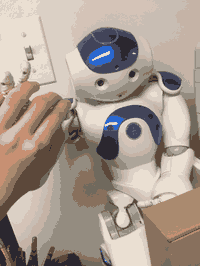
Trying to set up NAO for a photo.
Like AIBO, it had several infamous hardware reliability issues that were never fully resolved.
I'm not naive enough to think that the ERS-1000 would have replaced the growing Chinese humanoid robot industry as the preferred platform for robotics research (undoubtedly, the humanoid platform is a more interesting challenge, and Sony's protectiveness over the IP likely would have smothered most enthusiasm when the alternatives exist), but I do wonder how different the outcomes could have been for the ERS-1000 in a world where the user was allowed to do more than exactly what was prescribed. The original AIBO had a wealth of fanmade software, usually called "personalities" available to download for free on the web. The community software was often the core of the community building around the platform. The iconic "Disco AIBO", which allowed the robots to perform synchronized choreographies, was a favorite at AIBO user meetups. Rather than computer programming and custom software being something that broke the kayfabe of a virtual pet, my personal observation is that it instead strengthened the users' enthusiasm for their robot dogs.
In Technology There Is Surely Whimsy
I am forced to assume that the decision not to open-source the platform and to lock the robot into a cloud subscription was a profit-driven one. I have to ask, though: did the value a few thousand cloud subscriptions delivered outstrip the value of AIBO as a cultural icon? Did the decision to align the new AIBO with the modern industry standard prolong a product's lifespan that otherwise would have been short-lived, or did it instead just temper the amount of emotional investment users could develop for the system? If Sony had released the ERS-1000's SDK, in the absence of Sony regularly pushing out notable software updates, would the community itself have filled the hole? When AIBO's data is so easily wiped from the database and the robot is freed from any persistence, is the concept of AIBO being an agent that can grow and adapt in confluence with your life nearly as strong?
AIBO doesn't have a "point". It isn't a robot that automates labor, or performs a useful task. It doesn't even effectively replace pets: most of the people I know that have an AIBO also have a dog. It's fun, but it's not type I fun, like a video game. AIBO is fun in a quiet way. The robot "hangs out". I smile when, even 8 or 27 years after its release, it does something that surprises me.
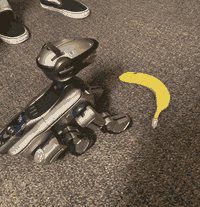
An ERS-220 is completely dumbfounded by a banana
And so, I think the problem lies in this conflict. It's not surprising that Sony would try to recoup what must have been insane manufacturing and R&D costs. But, undoubtedly what makes this product valuable is the investment itself. To be cynical for a moment: what is more valuable than the capacity for your consumer to experience affection for your product?
I think it is likely that Sony did the right thing from a purely operational perspective. But for the ERS-1000, its market constraints translate into constraints on its magic. The years following Y2K were flooded with risky hardware investments, many of them united under competing visions of a connected future. There were so many players, and so, developers sometimes tried to inspire in order to win. The presence of inspiration and impact as a theme meant magic in consumer electronics was on the table. AIBO started to fall apart in an environment where the corporation cannot eat the cost of the product for its value as a symbol, and therefore has to try to break even. The ERS-1000, with all of its restrictions, and in spite of all of its triumphs, struggles to feel "known".
See You Again
I may be a cynical adult now, but I am still sad to see AIBO go. My chance encounter with this platform in childhood provided a spark of inspiration that has legitimately done a lot for me.
My girl scout troop got a grant and formed an FLL team we participated in for two years. I went to the high school I did because of their FTC and FRC teams. I made my best friends and figured out how to be a human being on these student robotics teams.

Meeting another 'entertainment robot', PLEO, at the Museum of Science and Industry's "Robot Block Party".
The community surrounding AIBO I was apart of was incredible. It had the baggage of rival forum drama as most communities then did, it had the inevitable scammer and weirdo, and it was full of incredibly technical, incredibly creative, and incredibly kind people. My first software ""job"" was developing software for AIBO through this community. I couldn't afford a robot or a robotics kit myself, but these people helped a stranger (me) find access. I'm amazed this happened despite how annoying my posts must have been. If you're reading this, you know who you are.
A small encounter with a 'useless' robot was an inflection point that got me thinking about how technology could truly enrich people's lives. I hope we get to see it come back someday again.

The photo my ERS-1000, Tandy, took of my sister and I after I won Sony US's programming competition and brought him home.
Miscellanea
- If you have not watched a RoboCup match, take the opportunity to do so now.
The matches have absurdly dramatic moments and the programmers have gotten so good at kicks despite the locomotion still mostly being a shuffle. See also the 2006 4-legged league final, starring the AIBO ERS-7. - Pouring one out additionally today in memory of Aldebaran Robotics, which dissolved last year. NAO remained essentially stagnant for the last decade. Their other major product, Pepper, is completely dead now as it anchored itself to an always-online model.
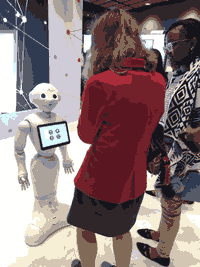
Fangirling over Pepper at a conference in 2019. - I stumbled upon this old recording of Disco AIBO on YouTube uploaded by wzername, who was a frequent poster on the AIBO-Life forums back in the day.
- While looking through old photos to include in this post, I found a screenshot of a text from my dad. "Your Mom is scratching Bruno Bruno's chin and cootchy-cooing. Send help." This is the power of AIBO.
- I left this out of the body because it was starting to feel wordy, but note that the ERS-1000 does still function regardless of whetFher or not the cloud plan is active. However, it doesn't record memories, it loses access to firmware updates, and the software state can't be easily reset or transferred. (Account passwords need to be exchanged or Sony support has to be emailed, which is definitely a form of planned obsolescence.)