Roadtripping for Computer Activities (VCFSW 2026)
A couple of weeks ago, a friend and I drove from Austin to Dallas to attend VCF Southwest. I was promised by internet people that it'd be a blast, so we braved the 7 cumulative hours of driving to make it out and back same-day. I figured if we deeply regretted it, at least we'd know not to attempt this in the future. When in Rome (Texas).
This event had truly good vibes despite being way larger in scale than I expected. It felt like there were more people tabling to show off their latest projects than there were people trying to make a sale. One guy didn't have socials, or a website to promote. He didn't even have an email. He just showed up to show off the chips he worked on at Sun.
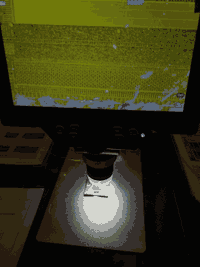
the UltraSPARC II under a microscope after some kind of planar grind.
Parking at VCFSW was free and the ticket was 25 dollars (20 dollars presale), so this adventure was shockingly affordable, gas aside. After walking in the front door, you collect your badge, optionally buy a tshirt with a cute armadillo using a computer on it and stumble into the first attraction: the "free table".
I can't say I found anything that really called to me at the free table, but my buddy immediately did. Behold:
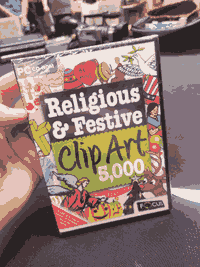
'Religious & Festive Clip Art 5,000'
I decided not to question his choice. I've yet to hear the review for this but please believe that the blog will be updated.
Onto the exhibition spaces. Immediately I stumbled into a hoard of Atari software. That morning officially began the quest to resurrect an Atari 800 my friend discovered years prior in the Terre Haute thrift, so we got where we needed to go quickly! One table, which I think was helmed by a local 8-bit computer users' group (which I couldn't find info on after the fact, sadly) was kind enough to explain to us how to open up the machine and check the RAM in BASIC.
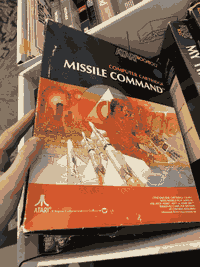
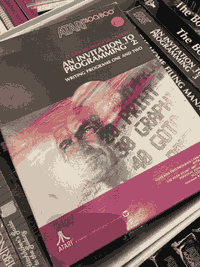
atari 400/800 software box art
Seeing box art for 8-bit computer games for the first time was sort of exciting, since it's an aspect of the experience that's totally lost when you're just playing someone's collection of warez. The box illustrations are genuinely extremely cool retro-futuristic imaginations of the software, and imagination IS necessary, because these games are best described as abstract art. Missile Command does not look like that, at all. But the illustration does allude to a setting that isn't described in the game, in a way that I can see enhancing the experience. Now I know I'm a dude in a chair defending a city from missile attacks and there's a contextual motivation beyond 'shooting the missiles is fun'. That seems to have sufficed for the great majority of people regardless, though.
Despite being a vintage computing event, there was some internet culture presence. There were a couple of YouTubers tabling, a Bad Apple demo, VRML running on a SGI box, some 2000's setups playing Source games, an OS-tan appearance and a ReactOS table printing holographic "my honest reactos" stickers. Of these, I was most surprised to see ReactOS (thought the project was dead, but no shade), and the VRML setup. I wrote about one of the few released applications of VRML, Sapari, years ago.
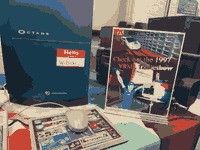
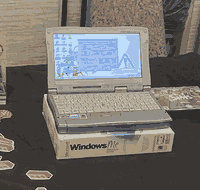
your favorite anime girls are VINTAGE!!
There were definitely too many cool projects to list. One guy built a parametron from scratch using essentially the only paper on the subject as the source. A table dedicated to computers sold in the Soviet Union delivered a history lesson I absolutely would not have encountered otherwise. From a group 100% dedicated to BASIC I learned that the Famicom had its own version, 'Family Basic', which came pre-loaded with Mario sprites.
After finishing up our rounds in the exhibition areas, we made our way toward the other side of the event space to see if we would catch any interesting panels. We did not see any panels. We did experience some environmental storytelling.
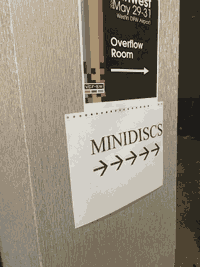
be not afraid
MINIDISCS → → → → →, says the sign, ominously off-center. OK, what could go wrong. We follow the sign. There is an entire room dedicated to minidiscs. There is a minidisc fan webpage running and everyone is checking in on the guestbook. One person shows us their display; 'the history of minidiscs'. "There was a long road before minidisc," they explain. "This is a sawblade. It's also a disc that makes sounds." I'm overwhelmed. It feels like I joined the wrong chatroom, but this is very real.
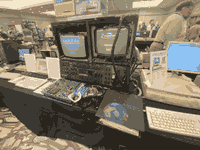
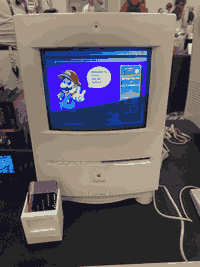
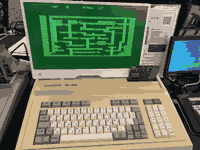
cool computer sightings
I slept in the next day, but the internet people were right-- VCFSW was a ton of fun. I guess I'll be back again next year :D!